Why Washington Let Baghdad Take the Kurds' Oil
The US used Iraq’s dependence on dollars to weaken the factions aligned with Iran and to put a banker in power. It now accepts Baghdad’s move on Kurdish oil, signaling it is reducing support to Kurds.
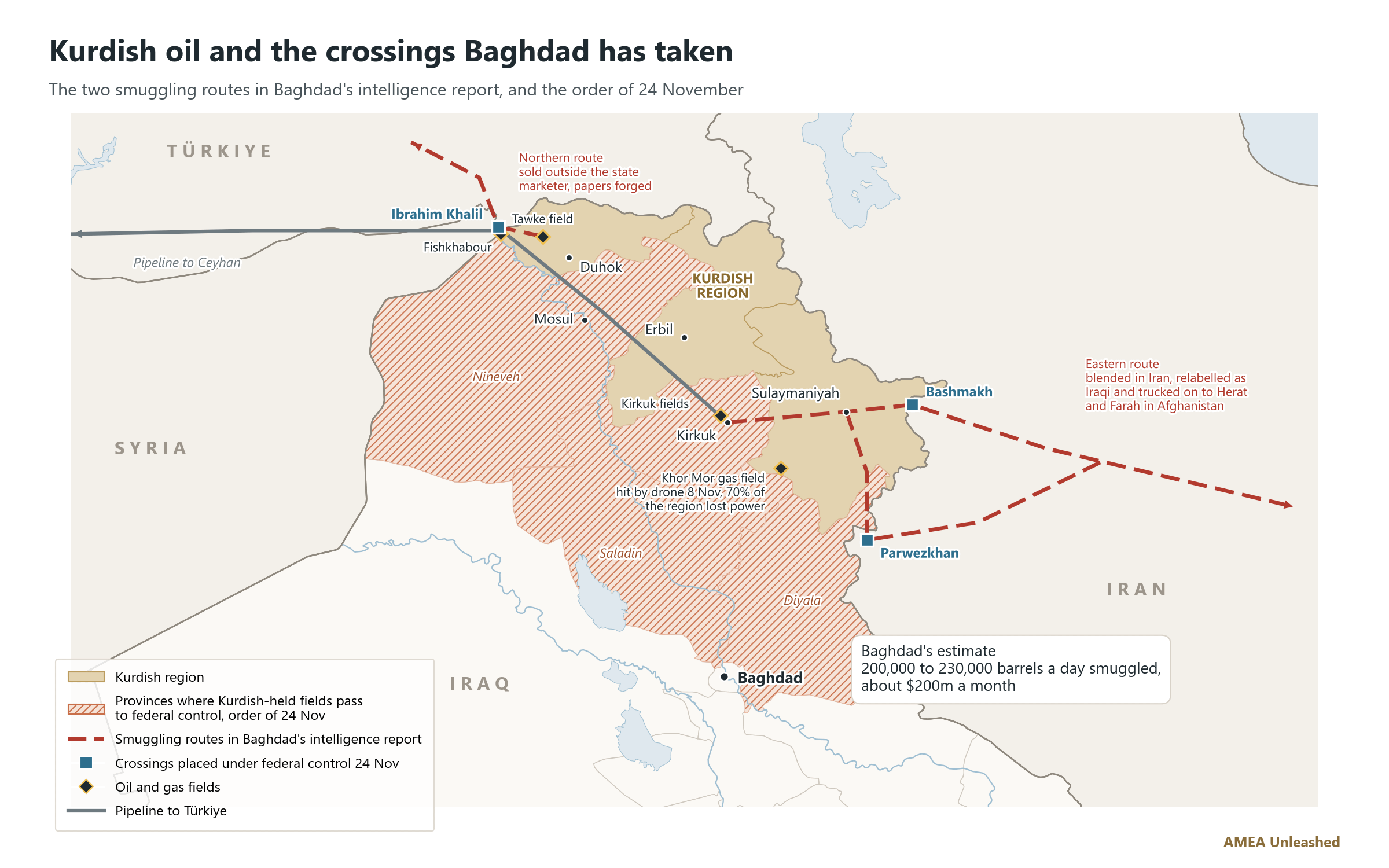
On 8 November, Iraq's foreign minister said the US Treasury had asked Baghdad to close every border crossing with Iran except two, one of them in the Kurdish region. Sixteen days later, the prime minister ordered the federal oil ministry to take over the oilfields under Kurdish security control in Kirkuk, Nineveh, Salahuddin and Diyala, placed the Kurdish region's border crossings under federal authority, and barred Erbil from exporting crude or fuel without Baghdad's approval. A government intelligence report released the same week named two of those crossings, Bashmakh and Parwezkhan, as the points where crude from Kirkuk enters Iran. On 25 November, the Federal Supreme Court ruled that federal troops may deploy on every international border, including those inside the Kurdish region.
The two main Kurdish parties, which had been feuding for months, called the order a red line in a joint statement. Thousands protested in Erbil on 26 November. Washington said nothing on the record. Earlier in the month, asked about the quarrel between the two Kurdish parties, the US envoy had said it was an Iraqi issue and an Iraqi decision, and that the Kurds should get over it. For two decades, the US protected the Kurdish region more closely than any other part of Iraq. Its oil and borders are now being taken by a government that Washington helped choose, as part of the pressure Washington is putting on Iran. It is unclear whether the Iraqi central government measures will be temporary or long-term, but what is certain is the US have used the Kurds yet again to undermine Iran and traded their security for its interests, whether in Syria, Iraq, Iran, or Turkey.
How Washington made Baghdad hungry
The US has the means to decide how Iraq behaves because it controls the money. Iraq sells its oil in dollars, the proceeds sit at the Federal Reserve Bank of New York, and the government can pay salaries only after those dollars are released and converted into dinars. In January, while the ruling Shia coalition was choosing a prime minister, US officials warned that Iraq could lose access to that account if figures from the factions aligned with Iran joined the government. The US president said Iraq would have no chance if the coalition's first choice, a former prime minister, returned to office. By April, the coalition had settled on a banker and businessman who had never held office. In the same month, about $500m in dollar banknotes bound for Baghdad was held back, the second shipment blocked since the war began. While the US troops may have left Iraq, the US continues to shape the Iraqi political landscape with the mighty dollar power.
Keep reading with a 7-day free trial
Subscribe to AMEA Unleashed to keep reading this post and get 7 days of free access to the full post archives.