The Fight for the Western Shore of the Red Sea
With the Houthis holding Yemen’s coast, the states of the Horn of Africa are fighting proxy contests over the African side of the sea, and over East Africa with it.
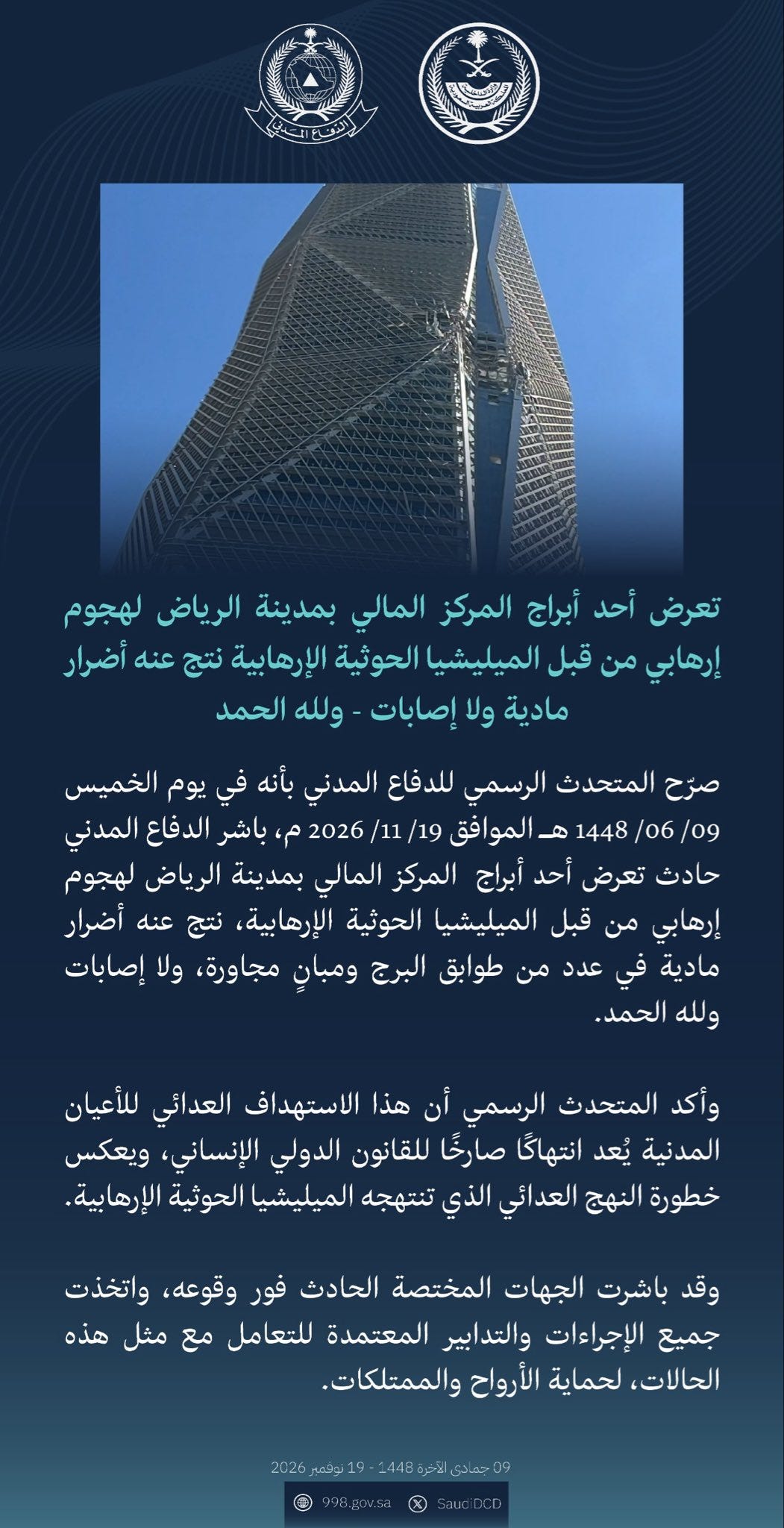
On 19 November, Somalia gave the UAE ambassador 72 hours to leave and recalled its envoy from Abu Dhabi. The same week, a Houthi missile hit the PIF Tower in Riyadh, the Saudi-led coalition began its heaviest bombing of Hodeidah, Sanaa and Saada in years, and the Houthis told shipping to keep away from Jeddah and every Saudi port on the Red Sea. On the Ethiopian and Eritrean border, drones and artillery struck around Badme overnight on 19 November, with both armies massed along a frontier of more than 1,000 km. Each is reported as a separate crisis, but they belong to a single contest. The Houthis now hold the eastern shore of the Red Sea, and by extension, shipping routes through it, and the fight is over who will hold the western one.
The eastern shore is settled
For most of the war in Yemen, the Houthis were a threat to shipping from the hills above the coast. In September 2026, they became the coast. They took Mokha, then Perim Island in the mouth of Bab el-Mandeb, then the Hanish Islands and the rest of Yemen's Red Sea shoreline, which puts their guns about 20 km from the African continent. Around 1,000 government soldiers from the islands crossed the strait and surrendered to Djibouti. A government counteroffensive in October reached Dhubab airfield, but on 15 November the government pulled back to defend Aden, and the Houthis returned.
Today, Houthis use that position to decide which ships pass. In July, they declared a blockade of Saudi Arabia, struck 2 Saudi tankers within days and hit the 400,000-barrel-a-day refinery at Jizan. They run a permit system for passage, answering requests within 24 hours, and Chinese tankers have obtained guarantees cargo by cargo. US shipping has been told it is safe, and the US has declined repeated Saudi requests to resume strikes. Traffic through Bab el-Mandeb reached 1,363 transits in October, the best month since the crisis began and still 46% below the level before it. Egypt took $10.25bn from the Suez Canal in 2023 and about $4bn in each of the following 2 years.
Eilat's port revenue fell from NIS 212m in 2023 to NIS 42m in 2024, and the port stopped operating in July 2025. Saudi Arabia, which moved most of its crude exports to Yanbu after Hormuz closed in March, now finds its Red Sea outlet within range of the same group. The Saudi answer in July was a coalition to protect the sea. 43 states attended its launch and 13 signed, among them Egypt, Türkiye, Qatar, Pakistan, Sudan, Somalia and Djibouti. The UAE did not sign. In practice, the coalition produced no naval deployments, and the help that came arrived by other routes. On 7 August, Saudi Arabia, Türkiye and Pakistan signed the Mecca Defence Agreement, amid Iranian and Houthi strikes on the kingdom, and in November Egypt confirmed that its troops and air defences were in Saudi Arabia to protect sensitive sites.
As the eastern shore of the Red Sea falls into Houthi hands, the African coast becomes the only shore any outside power can still build on. Whoever controls its ports, airfields and governments controls the western side of the Red Sea coast and, by extension, gains similar influence to the Houthis.
The West Red Sea camps and their proxies
The contest has sorted itself into 2 loose camps, and neither is a formal alliance. The first is anchored in Cairo and Riyadh. On 4 October, the leaders of Egypt, Eritrea, Sudan and Somalia met at El Alamein and declared the Red Sea the exclusive responsibility of the states on its shores, rejected any recognition of Somaliland and rejected unilateral action on the Nile. Every clause was aimed at Ethiopia, which has no coast, and at its partners. Egypt signed a maritime transport agreement with Eritrea in May, is reported to have secured access arrangements at Assab and at Doraleh in Djibouti, and has about 1,100 troops assigned to the African Union mission in Somalia, though their arrival has been delayed by funding. Saudi Arabia signed a military memorandum with Somalia in February, a week after Qatar signed its own defence agreement with Mogadishu. Türkiye sits on the same side of most of these lines and already has a strong presence in Somalia. It has F-16s and attack helicopters in Mogadishu, has trained at least 16,000 Somali soldiers, extended its deployment to July 2028, and holds rights at Suakin on the Sudanese coast, where it is now building gas terminals.
The second camp runs through Abu Dhabi and Tel Aviv. For a decade, the UAE built a chain of ports and bases along the African shore, from Assab in Eritrea to Berbera in Somaliland and Bosaso in Puntland. DP World holds 51% of Berbera under a $442m concession, and its subsidiary signed a $336m concession at Bosaso in 2017. The UAE left Assab in 2021, was ordered out of Yemen by the government it had backed in December 2025, and in 2026 Somalia cancelled every agreement with it, covering Berbera, Bosaso and Kismayo, and closed its airspace to Emirati military flights. The UAE moved its equipment out of Bosaso to Ethiopia, where Emirati aircraft have since been landing at Harar Meda air base. Sudan's army cut relations with the UAE in May 2025 and accuses it of arming the Rapid Support Forces. Algeria cut ties with the UAE in September over what it called increasingly hostile actions, as their rivalry spread across North Africa and the Sahel.
Israel recognised Somaliland on 26 December 2025, the first UN member state to do so, and opened mutual embassies in 2026. No Israeli base at Berbera has been confirmed, and Somaliland denies any such plan, but the Houthi leadership has twice named any Israeli presence there a target. In August, the US military signed an agreement with Puntland to expand a facility at Bosaso without passing through Mogadishu.
The proxy wars follow these lines. In Sudan, the army governs from Port Sudan with Egyptian, Saudi and Turkish support, while the Rapid Support Forces hold nearly all of Darfur, most of West Kordofan and the Heglig oilfield. In Ethiopia, the government accused Eritrea, Egypt and Sudan in September of arming a Tigrayan offensive, broke relations with Eritrea on 1 October, and expelled an Egyptian diplomat the same day. Eritrean troops entered Tigray in October before withdrawing. In Somalia, the federal government is fighting its own regions. Puntland and Jubaland rejected the cancellation of the UAE deals, Puntland seized a federal camp near Galkayo in August, and a former intelligence chief claims the leaders of Puntland, Jubaland and Somaliland met in the UAE to discuss removing the president.
A seabed worth fighting over
The contest is about geoeconomics as much as about geopolitics, and it resembles the eastern Mediterranean, where maritime lines agreed by 2 states are rejected by their neighbours. Ports are the first prize. Djibouti handled 96.71% of Ethiopia's seaborne cargo in the year to July 2026, at a cost to Ethiopia estimated at about $1.5bn a year, which is why Addis Ababa calls access to the sea irreversible and why every port deal along the coast is read as a move for or against it. Saudi Arabia has taken a 30-year concession for a $180m terminal at Tadjourah in Djibouti, and Sudan's transport ministry has given Saudi firms priority on its ports and railways, including Abu Amama, where a $6bn Emirati project was cancelled in 2024.
Gold is the second. The UAE took 99% of Sudan's official gold exports in 2024 and 56% in 2025, when the volume fell from 22.9 tonnes to 14.7 tonnes. Egypt's share rose from almost nothing to 4.9 tonnes, worth about $517m. Sudanese officials estimate production at about 70 tonnes, so most of the metal leaves outside official channels, and much of what reaches Egypt is re-exported to the UAE.
The seabed is the third. Atlantis II Deep, a field of zinc, copper, silver and gold about 2,000 m down in the joint Saudi and Sudanese zone, has never been licensed. In August, Sudan and Saudi Arabia set up a supreme council, and in September Sudan formed a committee to draw a maritime boundary with the kingdom. Egypt objects because the line touches Halayeb, the triangle it disputes with Sudan. Off Somalia, a Turkish drillship is boring Somalia's first offshore well, due to reach its target depth in December with no discovery so far. In Somaliland, a separate licence waits for 2027. About 15 subsea cables also cross the Red Sea, carrying more than 90% of data capacity between Europe and Asia, and 3 were cut near Jeddah in September 2025.
Overall, regional stability is becoming increasingly important and is seen as a necessary counterweight against the Houthis. Egypt benefits from the Suez toll regime, the Houthis decide which ships pass through a permit system of their own, and similar controls may arise on the western shore too.
Nobody has won
For all the money and men committed, no side holds the western shore. The UAE has lost Assab, Yemen and its legal footing in federal Somalia. Egypt has signed declarations and transport deals, but its troops have not deployed, and its canal still earns less than half what it did in 2023. Saudi Arabia leads a coalition that cannot keep its own refinery at Jizan, on its own Red Sea coast, out of range. Türkiye is the most physically present outside power in Somalia, but its oil well has not yet found anything. Ethiopia has an army, a growing population and Gulf partners, but no coast, and it is fighting Tigray and facing Eritrea at the same time. Israel has a flag in Hargeisa and no confirmed base.
The Houthis settled the eastern shore by physically taking it, not through proxy. They are now advancing on Aden. On the western shore, power is spread across failing federal states, rival armies and port concessions held by companies from 4 or 5 capitals, and each local war is fed from outside because a local winner would hand its backer the African side of the Red Sea. None of the competitors has managed it, and the wars in Sudan, Tigray and Somalia's regions will continue for as long as that prize stays open.
Follow AMEA Unleashed on X, YouTube, LinkedIn, Telegram, Instagram and TikTok.
Discussion about this post